In industrial automation, valve positioners play an important role in controlling valve movement accurately and reliably. As process control systems continue to develop, traditional mechanical valve positioners and intelligent valve positioners are now used in different application scenarios.
This article compares the two technologies from working principle, performance, and application selection.
What Is a Mechanical Valve Positioner?
A mechanical valve positioner controls valve position through a purely mechanical structure. It usually works based on a force-balance principle.
When the input signal changes, the internal mechanical components adjust the relationship between the nozzle, flapper, spring, and feedback mechanism. The actuator then moves the valve stem until a new balanced position is reached.
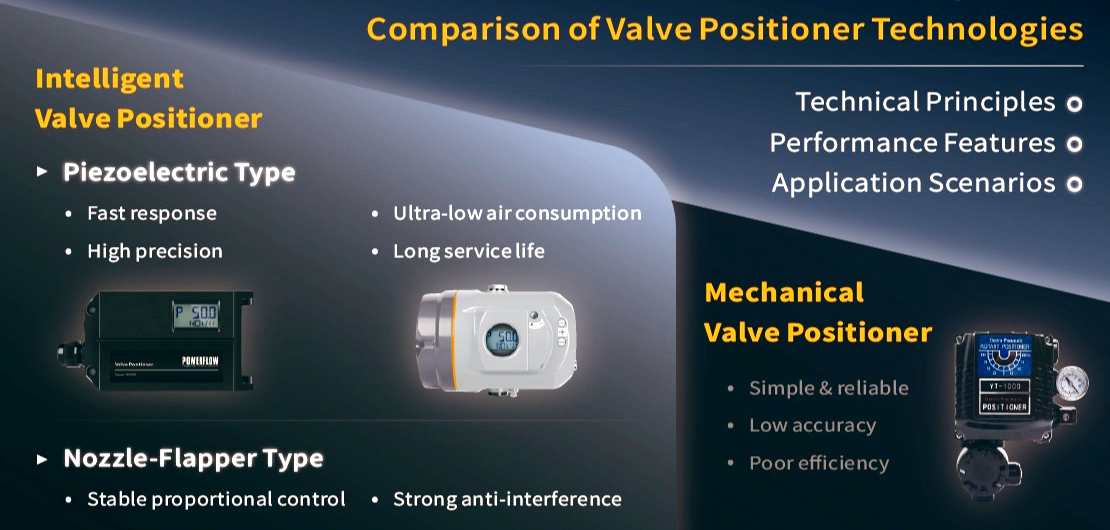
Mechanical positioners are simple, reliable, and do not require an external power supply. However, they also have limitations in accuracy, diagnostics, energy efficiency, and remote communication.
What Is an Intelligent Valve Positioner?
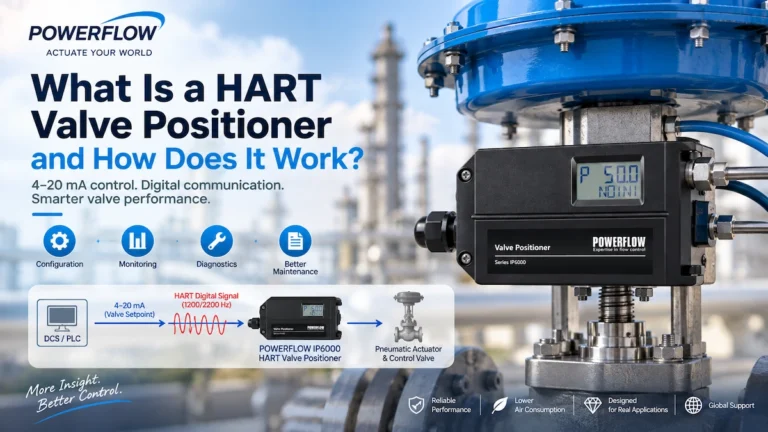
An intelligent valve positioner uses a microprocessor to process the input signal and valve feedback signal. Compared with traditional mechanical models, it offers more accurate control, better diagnostics, and stronger compatibility with modern automation systems.
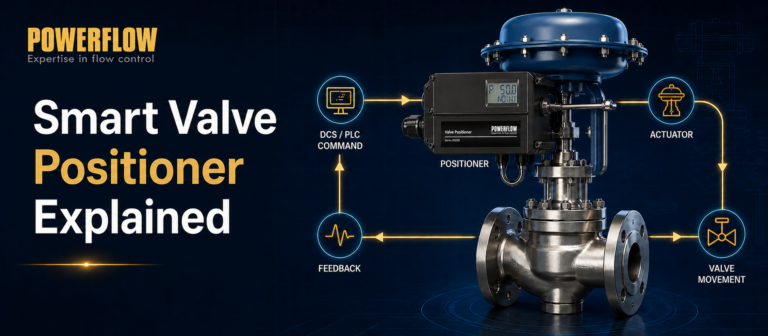
Intelligent valve positioners are commonly used in applications requiring precise valve control, low air consumption, remote monitoring, and predictive maintenance. For a detailed explanation of the control principle, read our guide to how a smart valve positioner works.
Main Technical Difference
The main difference lies in how the positioner processes and controls the valve movement.
Mechanical positioners rely mainly on mechanical force balance and pneumatic control. Intelligent positioners use electronic signal processing, microprocessor calculation, and advanced pneumatic control technology.
For example, the POWERFLOW IP6000 Series intelligent valve positioner uses a microprocessor and piezoelectric valve technology to control output pressure accurately. This helps improve positioning accuracy and reduce air consumption during operation.
Mechanical Valve Positioner: Advantages and Limitations
Mechanical valve positioners are suitable for simple control loops and applications where advanced functions are not required.
Main advantages include:
- Simple structure
- No external power supply required
- Suitable for basic pneumatic control systems
- Lower initial cost
Main limitations include:
- Lower control accuracy
- Limited diagnostic capability
- No digital communication
- Higher air consumption in some applications
- Less suitable for modern automated control systems
Intelligent Valve Positioner: Advantages and Applications
Intelligent valve positioners are designed for modern process industries where accuracy, efficiency, and maintenance visibility are important.
Main advantages include:
- Higher positioning accuracy
- Fast response
- Lower air consumption
- Digital diagnostics
- Remote monitoring capability
- Easier calibration and commissioning
- Better support for predictive maintenance
They are widely used in chemical, pharmaceutical, food and beverage, water treatment, oil and gas, power plants, and other process industries.
How to Choose the Right Valve Positioner
Mechanical valve positioners can still be used in simple systems, especially where the control requirement is not very high and the budget is limited.
Intelligent valve positioners are recommended when the application requires higher control accuracy, stable operation, low air consumption, remote diagnostics, or integration with modern control systems.
For critical process valves, intelligent positioners are usually the better long-term choice because they help improve control performance and reduce maintenance uncertainty.
Conclusion
Mechanical valve positioners are classic and reliable for basic applications. However, intelligent valve positioners provide better accuracy, lower air consumption, and stronger diagnostic functions.
As industrial automation moves toward higher efficiency and smarter maintenance, intelligent valve positioners are becoming the preferred solution for many modern process control applications.
POWERFLOW provides intelligent valve positioner solutions for different industrial valve applications, helping customers improve valve control performance and system reliability.