The Evolution of Intelligent Valve Positioners in Modern Industrial Automation
Introduction
In modern industrial process control, valve positioners have gradually evolved from simple auxiliary devices into critical components of intelligent automation systems. Especially in industries such as chemical processing, oil & gas, power generation, water treatment, and pharmaceuticals, the stability and responsiveness of valve control systems directly affect production efficiency, safety, and long-term operating costs.
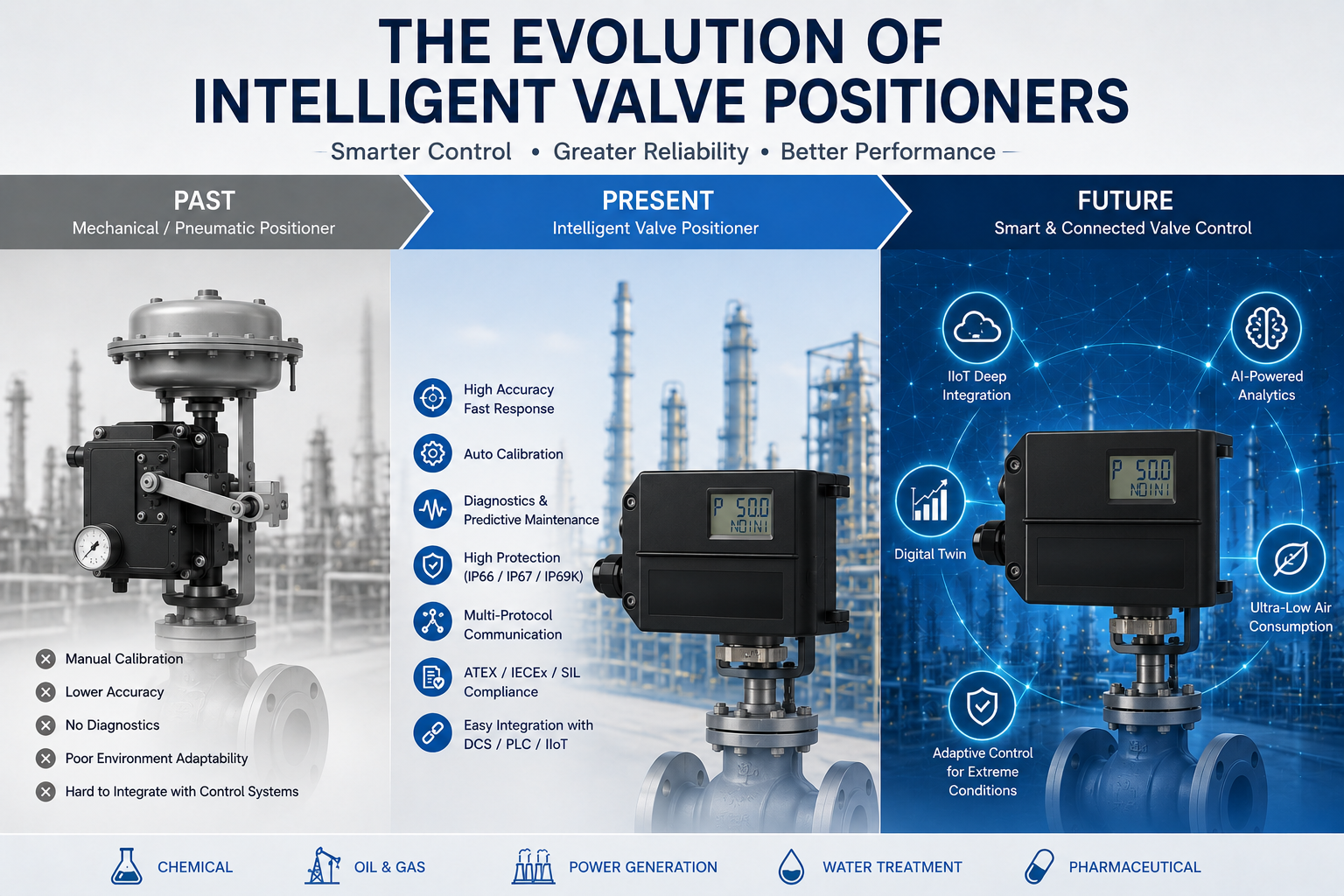
Over the past several decades, valve positioning technology has experienced a clear transition — from traditional pneumatic and mechanical control methods to digitally integrated intelligent valve positioners capable of diagnostics, communication, and predictive maintenance.
This evolution was not driven by technology alone. It was largely shaped by real industrial challenges: increasing labor costs, stricter safety standards, growing demand for process stability, and the rapid expansion of industrial automation systems worldwide.
Today, intelligent valve positioners are no longer viewed simply as control accessories. They are increasingly becoming part of a larger industrial data and asset management network.
The Early Days of Valve Positioning Technology
Before intelligent positioners became mainstream, most industrial control valves relied on pneumatic or mechanical positioning systems.
Traditional pneumatic positioners mainly operated through force-balance principles. Mechanical springs, flappers, nozzles, and feedback cams worked together to regulate actuator movement according to the input signal. These systems were widely used because of their relatively simple structure and stable operation under basic process conditions.
At the time, these technologies solved many important industrial control problems. They improved valve response compared with purely manual operation and helped factories achieve more stable process regulation.
However, as industrial production systems became larger and more complex, the limitations of early positioning technologies gradually became more obvious.
Limitations of Traditional Pneumatic & Mechanical Positioners
One of the biggest challenges of traditional positioners was calibration.
In large industrial facilities, valve commissioning often required technicians to manually adjust zero points, spans, springs, and cams on-site. For projects involving hundreds of control valves, this process could consume significant labor and startup time.
Positioning accuracy was also relatively limited. Mechanical wear, vibration, temperature changes, and air pressure fluctuations could all affect positioning stability over time.
Another major issue was the lack of diagnostic capability.
Traditional positioners could control valve movement, but they could not provide any visibility into valve health, actuator condition, air leakage, or abnormal operating behavior. Maintenance teams often had to wait until process instability or valve failure became visible before taking action.
In industries such as petrochemical processing or offshore energy production, this reactive maintenance model created substantial operational risk.
Environmental adaptability was another limitation. Older pneumatic systems were often vulnerable to:
- Humidity
- Dust
- Corrosive gas
- Vibration
- Salt spray
- Extreme temperatures
As industrial automation systems evolved, compatibility also became a growing concern. Traditional mechanical positioners could not easily integrate with modern DCS or PLC systems, making centralized monitoring and digital asset management difficult.
These challenges gradually pushed the industry toward a new generation of intelligent positioning technology.
Why Intelligent Valve Positioners Became Necessary
The rise of intelligent valve positioners was closely connected to broader industrial automation trends.
As factories pursued higher efficiency and more stable process control, valve systems were expected to provide not only movement control, but also operational feedback and maintenance visibility.
At the same time, industrial plants worldwide faced increasing pressure to reduce:
- Unplanned shutdowns
- Maintenance labor
- Energy consumption
- Commissioning complexity
- Production instability
This created demand for positioners capable of digital communication, self-calibration, and continuous diagnostics.
Intelligent valve positioners began to introduce microprocessor-based control systems capable of analyzing valve behavior in real time. Instead of relying purely on mechanical balance, these systems could dynamically optimize positioning performance according to process conditions.
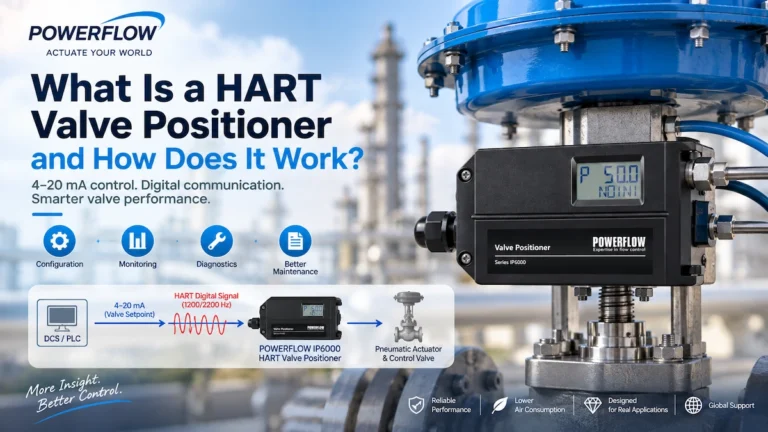
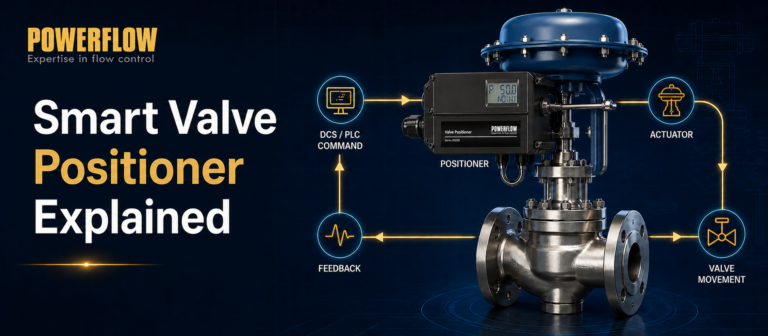
Learn more about the working principle and benefits of smart valve positioners.
The transition was especially important for large-scale projects where centralized process management became critical.
The Rise of Digital Valve Control
Modern intelligent valve positioners are fundamentally different from earlier pneumatic devices.
Today’s smart positioners combine:
- Electronic signal processing
- Pneumatic output regulation
- Digital communication
- Self-diagnostics
- Automated calibration algorithms
This allows the valve control system to operate with significantly higher accuracy and consistency.
One of the biggest improvements is communication capability.
Modern intelligent positioners commonly support protocols such as:
- HART
- Profibus PA
- Foundation Fieldbus
- 4-20mA analog integration
This multi-protocol compatibility allows easier integration into different plant control architectures, especially in retrofit projects where existing DCS systems vary between facilities.
For many overseas industrial users, compatibility is now one of the most important selection factors when upgrading valve automation systems.
Key Technologies Behind Modern Smart Positioners
Auto Calibration Technology
Auto calibration has become one of the most practical improvements in intelligent positioners.
In traditional systems, calibration often depended heavily on technician experience. Different operators could produce slightly different valve responses, especially during large project commissioning.
Modern auto-tuning algorithms simplify this process considerably.
The positioner can automatically identify actuator stroke characteristics, optimize control parameters, and establish stable positioning performance within a short setup period.
For EPC projects and large industrial plants, this reduces commissioning complexity and improves consistency across multiple production lines.
Diagnostic & Predictive Maintenance Functions
Diagnostic capability is another major shift in positioning technology.
Modern intelligent valve positioners can continuously monitor:
- Stroke deviation
- Air supply condition
- Actuator friction
- Valve travel behavior
- Response speed
- Signal abnormalities
Instead of waiting for a valve failure to interrupt production, maintenance teams can identify abnormal operating trends earlier and plan service schedules more efficiently.
This predictive maintenance approach is becoming increasingly important in industries where shutdown costs are extremely high.
High Protection for Harsh Industrial Environments
Industrial operating environments are often far more demanding than laboratory conditions.
In offshore platforms, chemical plants, mining facilities, and wastewater treatment systems, positioners may face:
- Continuous vibration
- Heavy moisture
- Corrosive atmosphere
- Salt exposure
- High-pressure cleaning
- Extreme outdoor temperatures
As a result, protection level has become an increasingly important specification.
Modern intelligent valve positioners now commonly feature:
- IP66
- IP67
- IP68
- IP69K
high-protection designs to improve long-term operational reliability.
For industries with hazardous environments, explosion-proof compliance is also critical.
International projects increasingly require certifications such as:
- ATEX
- IECEx
- SIL
particularly in Europe, the Middle East, and offshore energy sectors.
Why Compatibility & Compliance Matter More Today
In earlier industrial systems, many factories operated independently with localized equipment standards.
Today, global industrial projects often involve multinational EPC contractors, integrated DCS platforms, and standardized automation specifications.
This has significantly increased customer focus on:
- System compatibility
- Communication protocol support
- Certification compliance
- Interchangeability
- Long-term maintenance support
For many plant operators, the biggest concern is no longer simply whether a valve positioner works.
The real concern is whether it can operate reliably within a complex control network for many years without creating integration problems or maintenance uncertainty.
This is one reason intelligent valve positioners are increasingly selected for modernization projects.
Typical Industrial Applications Driving Smart Positioner Demand
Chemical Processing
Chemical plants require highly stable process control due to continuous operating conditions and sensitive reaction parameters.
Intelligent diagnostics help maintenance teams detect abnormal valve behavior before it affects production quality or process safety.
Oil & Gas
In offshore and hazardous-area applications, environmental resistance and explosion-proof compliance are critical.
Positioners used in these environments must maintain stable performance under vibration, salt spray, humidity, and temperature fluctuations.
Water Treatment
Water treatment facilities increasingly use centralized automation systems to manage large distributed valve networks.
Digital communication capability allows operators to monitor valve conditions remotely and reduce manual inspection workload.
The Future of Intelligent Valve Positioners
The next stage of intelligent valve positioning technology is closely connected to Industrial 4.0 and IIoT development.
Future positioners will likely become more deeply integrated into plant-wide digital asset management systems.
Rather than functioning only as control devices, they will increasingly serve as intelligent data nodes capable of continuously transmitting operational information.
Several development trends are already becoming visible.
Predictive Maintenance Expansion
Future diagnostic systems will likely become more advanced in identifying:
- Valve wear trends
- Air leakage patterns
- Actuator efficiency loss
- Process instability risks
This may further reduce unplanned downtime and improve maintenance scheduling accuracy.
Lower Energy Consumption
Compressed air consumption remains an important operating cost in large industrial facilities.
Future intelligent positioners are expected to continue improving pneumatic efficiency and low-air-consumption control strategies, especially as global industries place greater emphasis on energy saving and carbon reduction.
Deeper IIoT Integration
As industrial plants become increasingly connected, intelligent positioners will likely integrate more closely with:
- Cloud monitoring systems
- Remote diagnostics platforms
- Digital twin systems
- Centralized asset management software
This shift will gradually transform valve automation from isolated equipment management into full lifecycle digital management.
Engineering Experience and Industry Evolution
The development of intelligent valve positioners has also reflected the broader evolution of industrial manufacturing itself.
Over the years, many manufacturers in the valve automation industry have transitioned from early-stage technology imitation toward independent engineering development and application-driven innovation.
For companies deeply involved in valve automation applications, long-term experience in chemical processing, energy systems, and industrial control projects has become increasingly important for understanding real operating challenges rather than only theoretical specifications.
This practical engineering perspective continues to shape how modern intelligent positioners are designed for compatibility, reliability, environmental adaptability, and long-term maintenance efficiency.
Conclusion
The evolution from traditional pneumatic positioners to intelligent digital valve control systems reflects the changing demands of modern industrial automation.
As factories pursue higher reliability, lower maintenance costs, improved safety, and deeper digital integration, intelligent valve positioners are becoming a standard component of modern process control infrastructure.
While traditional positioning technologies still remain suitable for some basic applications, the overall industry direction is clearly moving toward smarter, more connected, and more diagnostic-oriented valve automation systems.
In the coming years, intelligent valve positioners will likely continue playing an increasingly important role in industrial efficiency, predictive maintenance, and integrated process management across global industries.